The bus slows down, and I look out the window.
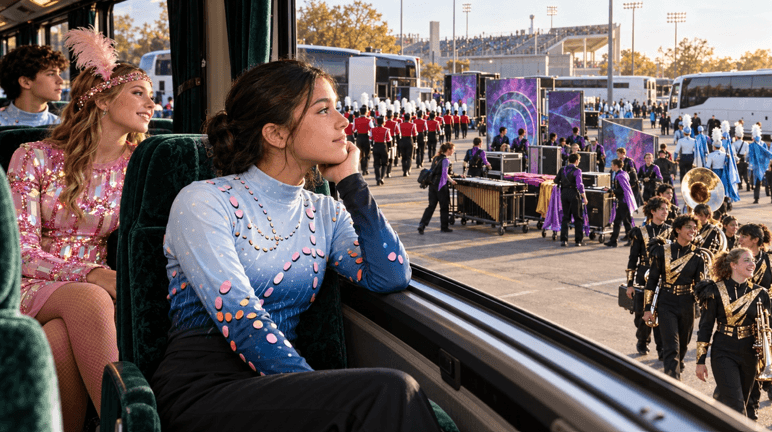
We’ve reached the contest lot.
A band in bright uniforms is walking toward the stadium in perfectly straight lines. Across the lot, another band is unloading painted scenery. Its color guard has costumes over their arms, and someone is wheeling a keyboard past our bus.
A third band is coming back from the field. They’re talking all at once as they carry their equipment toward their buses. Some are grinning. A few look like they’re still thinking about the show they just performed.
They don’t look much like the band with the scenery.
And neither band looks much like ours.
How can we all be marching bands and put on such different shows?
I Thought Marching Band Was Marching Band
When I first joined, I thought every band did more or less the same thing.
Learn the music.
Learn the drill.
Put on a uniform.
March onto a football field.
Now I’m watching bands arrive with different instruments, uniforms, and equipment. Some are getting ready to play traditional marches. Others have shows built around a story, with music I might recognize from a movie or music I’ve never heard before.
Each band seems to have its own idea of what a performance should feel like.
Look at the Band Walking Past Our Window
Their lines are so straight that I can see the spacing between people from my seat on the bus.
Everyone steps together. Everyone turns together. Even the way they carry their instruments looks precise.
They remind me of military-style marching.
In that tradition, the movement often emphasizes straight lines, consistent steps, sharp turns, and uniformity. The music may include traditional marches. A band doesn’t need scenery to hold your attention when every person is working to create that level of precision.
I keep watching, waiting for the next turn.
They all make it at once.
I have to admit, that looks hard.
What Are They Unloading Over There?
Across the lot, the other band is still moving equipment.
There are painted panels, platforms, instruments for the front ensemble, and what looks like an entire cart of electronics. Several color guard members are carefully carrying costumes they haven’t put on yet.
I can’t tell what their show is about from the parking lot.
But I want to find out.
Their production may draw on corps style, which has influenced many competitive marching bands. The music and movement work together to take the audience somewhere. Formations may curve, break apart, and come back together. The band might move backward, sideways, or at a run.
A prop might change what a musical moment means. The color guard might give the audience its first clue about the story.
Sometimes there’s a title in the program, and you spend the show discovering why it fits.
I’ve watched a band make the whole stadium go quiet with a single solo. Then, a few minutes later, they played a final chord that made everyone jump to their feet.
That’s a different kind of excitement from watching a perfectly straight line cross the field.
I like both.
Then I Hear the Brass
A powerful burst of music reaches us from somewhere beyond the buses.
I turn toward the window, but I can’t see who’s playing. I hear percussion underneath it, and it sounds as though a crowd is answering back.
Some marching traditions put that exchange with the audience at the center of the performance. HBCU marching bands have created some of the most celebrated examples, combining strong brass and percussion, high-stepping movement, dance, familiar music, and showmanship.
The crowd becomes part of the energy.
Other bands build their shows around the traditions of college football: fight songs, school symbols, pictures made on the field, and musical moments designed to make a stadium cheer.
Those performances can look effortless from the stands.
I know better.
You don’t make a whole crowd react together without a lot of rehearsal.
The Music Changes Everything
I used to notice uniforms and props first. Now I’m listening, too.
One band’s show might sound bold and traditional, with a march that makes you want to sit up straighter.
Another might open with a quiet woodwind melody, bring in electronics, and build toward a huge brass impact.
A third might play music the audience already knows and invite everyone to share in it.
The style isn’t just how a band marches.
It’s what the band chooses to play, how it plays it, how it moves, and what it wants the audience to feel.
That’s why the same field can seem so different from one performance to the next.
Where Does Our Band Fit?
I look down at my own uniform.
Our show has a straight line that took us weeks to clean. It has a sweeping curve I love being part of. There’s a color guard moment I always try to catch out of the corner of my eye, even though I’m supposed to be watching the drum major.
Our opener makes me want to run onto the field.
The quiet section makes me hold my breath.
So what style are we?
Maybe we don’t need just one answer.
Our director and designers chose the music and movement that fit our show. The precise line matters. So does the curve. So does the moment when almost everyone stops moving and the music carries the whole stadium.
All those choices help us say something together.
Now I Want to Watch Them All
The bus door opens, and everyone starts gathering their things.
Before I stand up, I take one more look outside.
The band with the scenery is almost ready to go. The precise band has disappeared toward warm-up. Another band is coming back, still talking about its performance.
Soon it will be our turn.
Later, if I get the chance to watch, I want to pay attention to more than who plays loudest or whose lines are straightest.
I want to hear what each band does with its music.
I want to see how it moves, how its color guard adds to the performance, and what makes the audience lean forward or cheer.
We all arrived here on band buses. We’ll all perform on the same field. Yet every band will bring its own sound, its own movement, and its own way of connecting with the crowd.
And I really love our show this year.
I think it’s a winner. In a few hours, we’ll find out whether the judges agree.
Whatever the results, I already know one thing:
I’ll be riding home with winners.