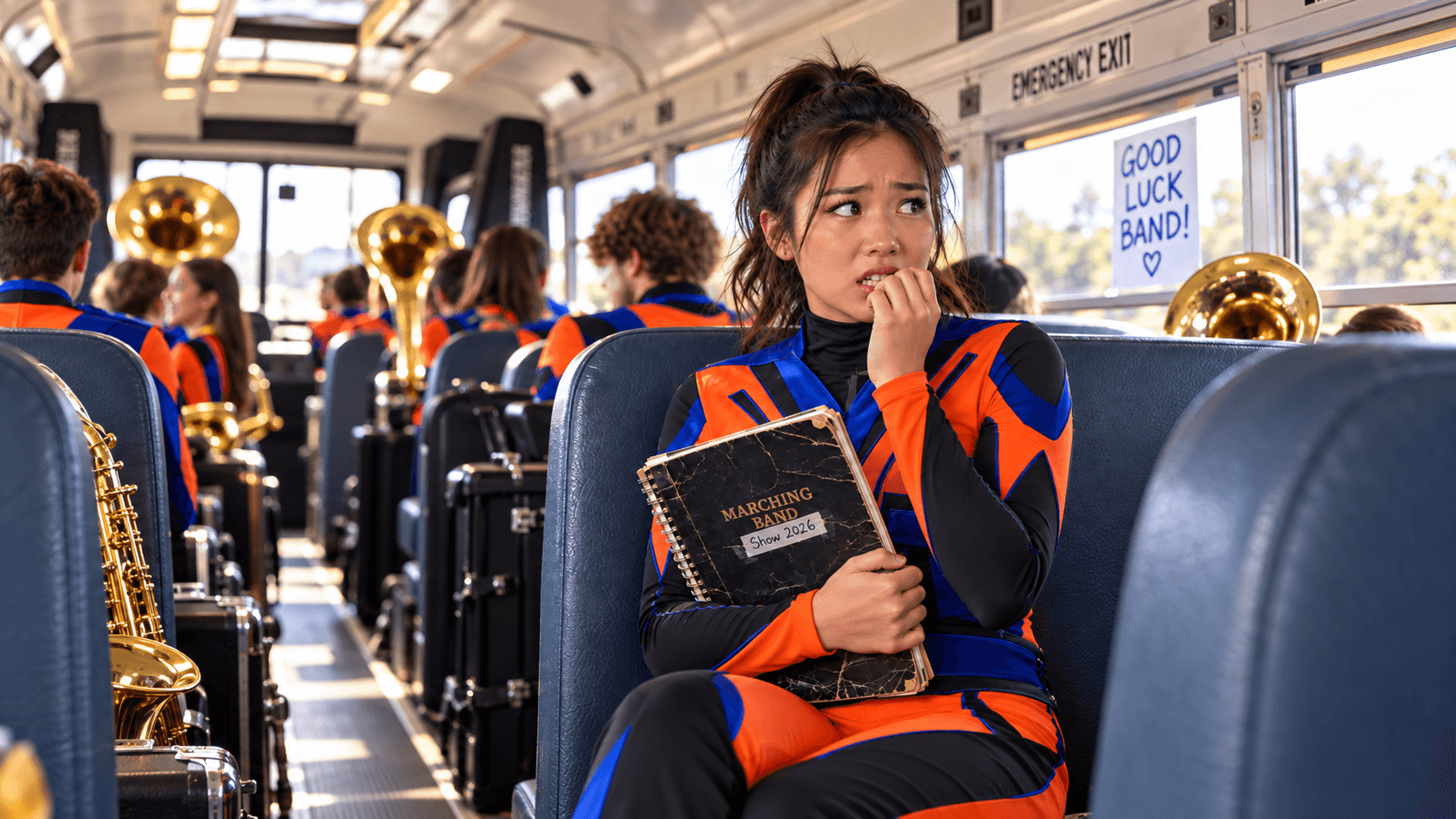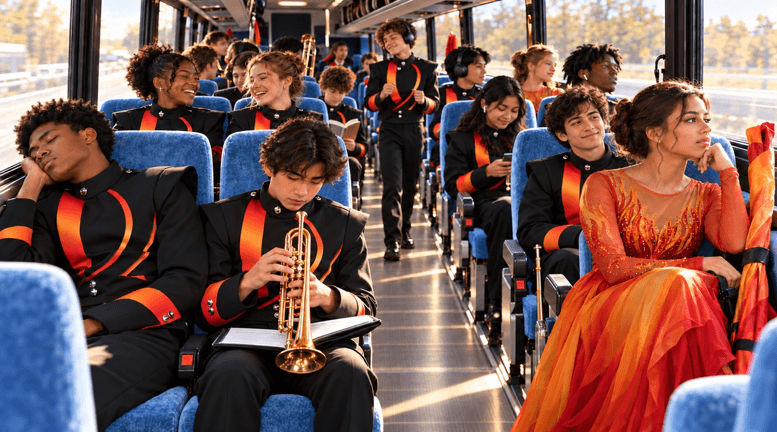
You know the feeling.
The bus gets quieter.
The contest site gets closer.
Someone starts checking their uniform for the seventh time.
Someone else is tapping fingers against a knee.
And somewhere in your brain, a very unhelpful little voice begins saying:
What if I miss the entrance?
What if I forget the drill?
What if I crack the note?
What if I drop something?
What if I completely embarrass myself in front of several thousand people and have to move to another state?
That last one is probably unlikely.
But before a performance, your brain does not always specialize in reasonable thoughts.
That is where laughter can help.
Your Body Cannot Stay Tense Forever
When you are nervous, your body prepares itself for danger.
Your heart may beat faster.
Your breathing may become shallow.
Your shoulders tighten.
Your stomach starts doing something that nobody ordered.
That nervous response is useful if you are being chased by a bear.
It is less useful when you are waiting to perform the opening statement of your marching show.
Laughter can interrupt some of that tension.
A good laugh changes your breathing. Your face relaxes. Your shoulders may loosen. For a moment, your attention moves away from everything that could go wrong and toward something completely harmless and ridiculous.
That does not mean laughter magically eliminates performance anxiety.
It means it can help break the cycle of nervous thinking.
And sometimes that little break is exactly what you need.
Create Your Own Personal Laughter
You should never depend on somebody else to make you laugh.
Build your own emergency supply.
Think of it as a performance-day survival kit.
You might create a folder on your phone called:
Break Glass In Case Of Nerves
Fill it with things that reliably make you smile:
Funny photos
Memes
Clean comedy clips
Ridiculous family pictures
Favorite movie scenes
Band jokes
Screenshots of funny text conversations
Stories from rehearsal
A list of things your director has accidentally said
Pictures of your friends making terrible faces
The important part is that you already know they make you laugh.
Contest day is not the time to begin searching the internet for something funny.
Bring your comedy with you.
You May Actually Need A Joke Book
Yes.
A joke book.
An actual old-fashioned collection of jokes may deserve a place in the band bus.
You do not need brilliant comedy.
In fact, terrible jokes may work better.
The joke is almost beside the point.
The goal is to make someone groan, laugh, roll their eyes, and temporarily forget that they are worrying about Measure 47.
Here are a few to get you started.
Why did the band director bring a ladder to rehearsal?
Because the band needed to reach a higher level.
Why was the percussionist standing outside the school?
Because someone told him to wait for his cue.
Why couldn't the trumpet player find the music?
It was under too much brass.
What is a trombone player's favorite kind of slide?
All of them.
Why did the piccolo refuse to argue?
It preferred to stay above it all.
Why did the drum major bring a pencil onto the field?
To draw attention.
Why are marching band members good travelers?
They already know how to stay in step.
Why did the sousaphone get invited to every party?
Because it always brought something big to the conversation.
They do not have to be good.
Sometimes the worse they are, the better.
Write Your Own Terrible Jokes
This is where things get even better.
Get three or four friends together and deliberately try to write the worst band jokes imaginable.
Try this formula:
Instrument + strange situation + ridiculous ending
For example:
A bassoon walks into a restaurant...
A cymbal player applies for a job...
A drum major goes to the dentist...
A clarinet gets pulled over for speeding...
Do not worry about being clever.
You are trying to create laughter, not win a comedy award.
The Band Bus Limerick Challenge
A limerick is a short, silly five-line poem.
The usual pattern is: A A B B A
And band kids are almost genetically designed to write terrible limericks.
Here are a few beginnings.
There once was a tuba player from Tupelo, Who practiced wherever he'd go. He played such a blast, That windows shook fast, And traffic moved three blocks below.
Peter Paulson picked the piccolo, And practiced wherever he'd go. He played it so high, That birds left the sky, And dogs started walking real slow.
When the color guard's guard is down, There's usually laughter around. A flag takes a flight, Someone ducks to the right, Then everyone bows to the ground.
Now make your own.
Give your friends a first line and let everyone finish it.
Try:
There once was a drummer named Fred...
A trumpet player sat in the stands...
Our drum major came from Peru...
A clarinet fell from a chair...
There once was a marcher named Sue...
The worse the rhyme, the better.
Laugh At The Situation — Not At The Person
There is one rule.
Performance-day humor should make people feel better, not smaller.
Do not make jokes about:
Someone's playing ability
Someone's body
Someone's mistake
Someone's family
Someone's accent
Someone's religion
Someone's identity
Something you know embarrasses another person
The goal is to lower anxiety.
If someone becomes the target of the joke, you have defeated the purpose.
The best band humor is usually about the strange things everybody experiences together.
The forgotten plume.
The bus that smells unusual.
The mysterious glove that belongs to nobody.
The director saying, "One more time," fifteen times.
The prop that suddenly develops a personality.
Those things belong to everybody.
Keep A Band Comedy Journal
Here is another idea.
During the season, write down funny things that happen.
Not everything.
Just the moments you know you will want to remember.
Maybe someone says something hilarious during rehearsal.
Maybe a prop goes the wrong direction.
Maybe somebody forgets where the bus is parked.
Maybe the entire clarinet section somehow arrives wearing the wrong socks.
Write it down.
By contest season, your group may have its own private comedy collection.
Pull it out before a performance.
Sometimes remembering how much fun you have had together reminds you why you are doing this in the first place.
The 60-Second Laughter Reset
If your nerves are getting strong just before warm-up, try this.
For one minute:
Find someone you trust.
Each of you tells the other the worst joke you know.
Then deliberately laugh at it.
Yes, deliberately.
Fake laughter often becomes real laughter surprisingly quickly.
Then take one slow breath.
Drop your shoulders.
And say: “All right. Let's go perform.”
You have just given your nervous system something else to do.
Remember Why You Are Nervous
You are probably nervous because you care.
You worked for this.
Your friends worked for this.
Your teachers worked for this.
You want it to go well.
There is nothing unusual about feeling nervous before doing something important.
But you do not have to sit there feeding the nervousness all the way to the stadium.
You can talk.
You can breathe.
You can listen to music.
You can close your eyes.
And sometimes...
you can tell the worst tuba joke ever written.
Then laugh.
Because in a few minutes, you are going to step onto a field and do something most people will never experience.
You are going to make music with your friends.
You are going to move together.
You are going to perform something you have spent weeks building.
And for several minutes, the entire stadium belongs to you.
So. before you get there:
Laugh a little.
Breathe a little.
Worry a little less.
Then go perform.